Perforated Alumina Ball
Perforated alumina balls are a new product developed from inert alumina balls, with holes drilled along the sphere diameter axis. They retain the mechanical strength, chemical stability and thermal st
Product Code: XQ-CB-PER
Product Overview
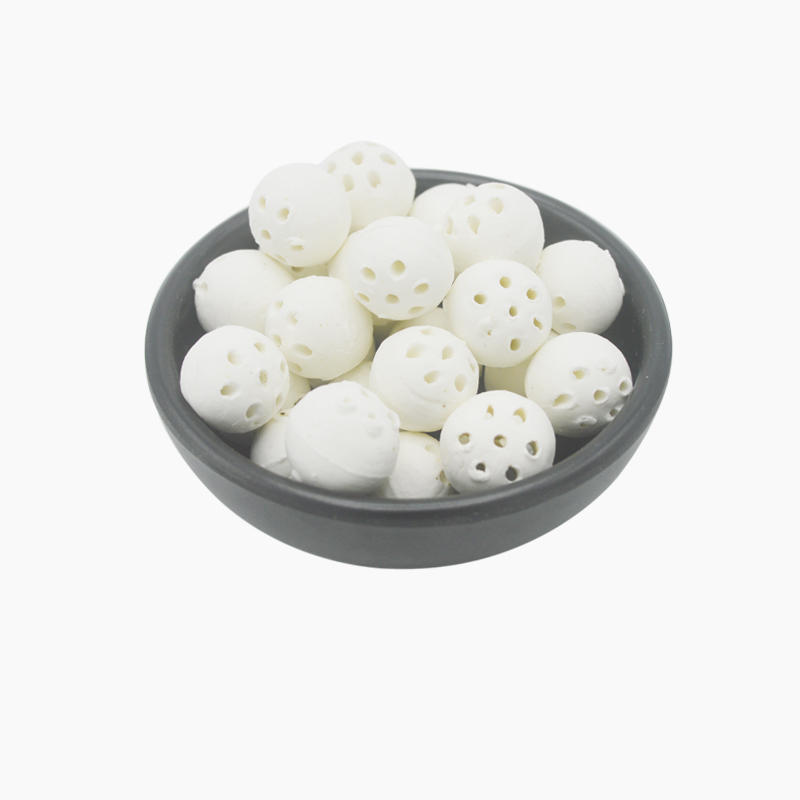
Perforated alumina balls are a new product developed from inert alumina balls, with holes drilled along the sphere diameter axis. They retain the mechanical strength, chemical stability and thermal stability of inert balls while adding specific surface area and void fraction, improving material dispersion and throughput and reducing system pressure drop. Since launch they have been widely used in the petroleum, chemical and natural gas industries as catalyst support and cover media in place of inert balls. They are white spheres with mutually perpendicular holes; the number of holes (single, three, five or seven) can be selected according to application and ball size.
Applications
Perforated alumina balls distribute fluid uniformly in purification reactors, enabling uniform and efficient mass and heat transfer. They prevent reactants and heat from concentrating locally, avoid uneven reaction, and protect the catalyst from overheating, coking and shortened life. Applied in packed towers in refining, petrochemical, fertilizer, methanol, coal-chemical, natural-gas chemical, smelting, environmental and fine-chemical industries — for example methanol plants (oil-removal, crude desulfurization, zinc-oxide desulfurization, naphthalene-removal, pre-hydrogenation, first/second-stage hydrogenation, first/second-stage desulfurization vessels and methanol synthesis reactors); medium/low-temperature shift converters, methanol synthesis towers, desulfurization tanks and dehydrogenation reactors in coal-chemical methanol-ammonia co-production; ethylene aromatics extraction, sulfur-recovery acidic-water stripping and etherification units in petrochemicals; as well as natural-gas drying adsorbers, full-range distillate hydrotreaters, ammonia shift converters and flue-gas acid converters.
Request a QuoteTechnical Specifications
corundum Perforated ball
| Perforated ball-corundum | |||
|---|---|---|---|
| Physical & chemical properties | Unit | Value | |
| Al 2 O 3 | % | ≥ 90 | |
| Al 2 O 3 +SiO 2 | % | ≥90 | |
| Fe 2 O 3 | % | ≤1 | |
| Water absorption | % | ≤5 | |
| Acid resistance | % | ≥90 | |
| Alkali resistance | % | ≥85 | |
| Thermal shock resistance | ℃ | ≥300 | |
| Max. service temperature | ℃ | 1500 | |
| Bulk density | kg/m 3 | ≥ 1600 | |
| Crushing strength | Ф10mm | KN/piece | ≥1.20 |
| Ф13mm | ≥1.80 | ||
| Ф16mm | ≥2.60 | ||
| Ф20mm | ≥3.20 | ||
| Ф25mm | ≥4.50 | ||
| Ф30mm | ≥5.00 | ||
| Ф38mm | ≥6.50 | ||
| Ф50mm | ≥10.00 | ||
| Ф76mm | ≥16.00 | ||
| Applicable standard:HG (Chemical Industry Standard of China)HG/T3683.3-2014《Industrial ceramic ball——Perforated ball》 |
high-alumina Perforated ball
| Perforated ball-high-alumina | |||
|---|---|---|---|
| Physical & chemical properties | Unit | Value | |
| Al 2 O 3 | % | 71-90 | |
| Al 2 O 3 +SiO 2 | % | ≥90 | |
| Fe 2 O 3 | % | ≤1 | |
| Water absorption | % | ≤5 | |
| Acid resistance | % | ≥90 | |
| Alkali resistance | % | ≥85 | |
| Thermal shock resistance | ℃ | ≥300 | |
| Max. service temperature | ℃ | 1400 | |
| Bulk density | kg/m 3 | 1400~1600 | |
| Crushing strength | Ф10mm | KN/piece | ≥1.00 |
| Ф13mm | ≥1.60 | ||
| Ф16mm | ≥2.30 | ||
| Ф20mm | ≥2.80 | ||
| Ф25mm | ≥4.00 | ||
| Ф30mm | ≥4.50 | ||
| Ф38mm | ≥6.00 | ||
| Ф50mm | ≥9.00 | ||
| Ф76mm | ≥15.00 | ||
| Applicable standard:HG (Chemical Industry Standard of China)HG/T3683.3-2014《Industrial ceramic ball——Perforated ball》 |
mid-alumina Perforated ball
| Perforated ball-mid-alumina | |||
|---|---|---|---|
| Physical & chemical properties | Unit | Value | |
| Al 2 O 3 | % | 46-70 | |
| Al 2 O 3 +SiO 2 | % | ≥90 | |
| Fe 2 O 3 | % | ≤1 | |
| Water absorption | % | ≤5 | |
| Acid resistance | % | ≥90 | |
| Alkali resistance | % | ≥85 | |
| Thermal shock resistance | ℃ | ≥300 | |
| Max. service temperature | ℃ | 1300 | |
| Bulk density | kg/m 3 | 1300~1400 | |
| Crushing strength | Ф10mm | KN/piece | ≥0.90 |
| Ф13mm | ≥1.40 | ||
| Ф16mm | ≥2.00 | ||
| Ф20mm | ≥2.50 | ||
| Ф25mm | ≥3.50 | ||
| Ф30mm | ≥4.00 | ||
| Ф38mm | ≥5.50 | ||
| Ф50mm | ≥8.00 | ||
| Ф76mm | ≥13.00 | ||
| Applicable standard:HG (Chemical Industry Standard of China)HG/T3683.3-2014《Industrial ceramic ball——Perforated ball》 |
low-alumina Perforated ball
| Perforated ball-low-alumina | |||
|---|---|---|---|
| Physical & chemical properties | Unit | Value | |
| Al 2 O 3 | % | 31-45 | |
| Al 2 O 3 +SiO 2 | % | ≥90 | |
| Fe 2 O 3 | % | ≤1 | |
| Water absorption | % | ≤5 | |
| Acid resistance | % | ≥90 | |
| Alkali resistance | % | ≥85 | |
| Thermal shock resistance | ℃ | ≥300 | |
| Max. service temperature | ℃ | 1200 | |
| Bulk density | kg/m 3 | 1200~1300 | |
| Crushing strength | Ф10mm | KN/piece | ≥0.80 |
| Ф13mm | ≥1.20 | ||
| Ф16mm | ≥1.80 | ||
| Ф20mm | ≥2.20 | ||
| Ф25mm | ≥3.00 | ||
| Ф30mm | ≥3.50 | ||
| Ф38mm | ≥5.00 | ||
| Ф50mm | ≥7.00 | ||
| Ф76mm | ≥12.00 | ||
| Applicable standard:HG (Chemical Industry Standard of China)HG/T3683.3-2014《Industrial ceramic ball——Perforated ball》 |
ordinary Perforated ball
| Perforated ball-ordinary | |||
|---|---|---|---|
| Physical & chemical properties | Unit | Value | |
| Al 2 O 3 | % | 20-30 | |
| Al 2 O 3 +SiO 2 | % | ≥90 | |
| Fe 2 O 3 | % | ≤1 | |
| Water absorption | % | ≤5 | |
| Acid resistance | % | ≥90 | |
| Alkali resistance | % | ≥85 | |
| Thermal shock resistance | ℃ | ≥300 | |
| Max. service temperature | ℃ | 1000 | |
| Bulk density | kg/m 3 | 1100~1200 | |
| Crushing strength | Ф10mm | KN/piece | ≥0.60 |
| Ф13mm | ≥1.00 | ||
| Ф16mm | ≥1.50 | ||
| Ф20mm | ≥1.80 | ||
| Ф25mm | ≥2.50 | ||
| Ф30mm | ≥3.00 | ||
| Ф38mm | ≥4.00 | ||
| Ф50mm | ≥6.00 | ||
| Ф76mm | ≥10.00 | ||
| Applicable standard:HG (Chemical Industry Standard of China)HG/T3683.3-2014《Industrial ceramic ball——Perforated ball》 |
Why XINQUAN
High-purity alumina delivers exceptional mechanical strength.
Resists acids, alkalis and organic solvents for long service life.
Stable under high temperature and thermal cycling conditions.